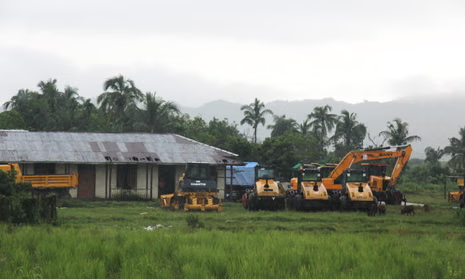
The Arakan Army (AA) has been constructing new settlements for Buddhist Rakhine families in Rohingya-inhabited areas of Maungdaw, Rathedaung, and Buthidaung townships in Myanmar’s Rakhine State, according to a December 7 report by the Rakhine-based news outlet Rohingya Khobor.
The report states that the United League of Arakan (ULA), the AA’s political wing, has initiated a population expansion program in areas depopulated after large numbers of Rohingya fled to Bangladesh. Over recent months, lists have reportedly been compiled to bring Rakhine families from different parts of the region into Maungdaw.
Eight villages in northern Maungdaw—now said to be fully transformed into Rakhine settlements—have been identified. These include Nwar Yone Taung, Khawli Zarr, Kyikanpyin, Wabet, Phar Wap Chaung, Myo Taung, and Kyain Chaung.
Meanwhile, human rights organization Fortify Rights reports that the AA has been enforcing forced labor in areas under its control. After making significant territorial gains in Rakhine in 2024, the armed group allegedly began requiring at least one member from each Rohingya family—usually men—to work for periods ranging from a single day to several months.
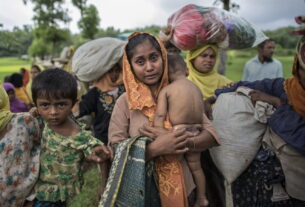
More than 800,000 Rohingya fled to Bangladesh following the Myanmar military’s brutal crackdown in August 2017. Today, Bangladesh hosts more than 1.4 million Rohingya refugees in total.
The United Nations reports that between July 2024 and December 2025, around 170,000 additional Rohingya fled to Bangladesh amid renewed conflict in Rakhine.
Rohingya Witness Accounts of Land Grabbing and Settlement Construction
To understand the current situation on the ground, Dhaka Post contacted Rohingya refugee Nurul Amin, who fled from Sikdar Para in Maungdaw to Camp 18 in Ukhiya last June.
Quoting a relative still in Maungdaw, he said:
“My cousin still lives in Maungdaw town. Four or five days ago, he told me on the phone that the Arakan Army has built new houses in Taungpyo Left and in our neighborhood. Rakhine families are now living in what used to be our homesteads.”
He added, “They are taking our agricultural land as well. A few Rohingya who tried to resist faced torture.”
Another Rohingya youth, Arif Ullah, said:
“The houses we left behind are now occupied by others through the Arakan Army. They want to erase our existence, but one day we will return.”
He also mentioned that reception centers built by the Myanmar government after 2017 to prepare for Rohingya repatriation are now being used by the AA and its allies.
Rohingya Leadership and Community Voices Demand Urgent Action
Master Syed Ullah, president of the Rohingya community organization United Council of Rohang (UCR), said:
“Arakan is our ancestral land. Our only goal is repatriation, and we will return home soon.”
He accused the AA of widespread abuses:
“They have evicted our relatives and occupied their homes. If this continues, Rakhine State may be completely emptied of Rohingya. The world must not remain silent—urgent action is needed.”
Local communities in Ukhiya and Teknaf—who have long borne the burden of hosting massive refugee populations—also expressed desire for a durable solution. Engineer Robiul Hossain, president of the Local Rights Implementation Committee, told Dhaka Post:
“We want a sustainable and just solution. Local residents are already facing many challenges due to the refugee influx. Without a resolution, the future looks increasingly difficult.”
Bangladesh’s Refugee Relief and Repatriation Commissioner (RRRC), Mizanur Rahman, said that the government is working with national and international partners to secure a lasting solution.
“Repatriation is the only effective remedy,” he said. “At the same time, ensuring the safety, dignity, and humanitarian protection of Rohingya refugees in the camps remains a priority.”
Arakan Army’s Territorial Control Remains Contested
On December 10, 2024, after prolonged fighting with Myanmar’s junta forces, the Arakan Army claimed to have taken control of roughly 271 kilometers of territory along the Bangladesh–Myanmar border in Maungdaw.
However, despite a year of conflict, the group—established in 2009—has not yet achieved full control of Rakhine State. Although the AA claims dominance over 14 townships, recent months have seen renewed military pushback in several areas.
The key townships of Sittwe, Kyaukphyu, and Manaung remain under strong junta control and outside the AA’s grasp.