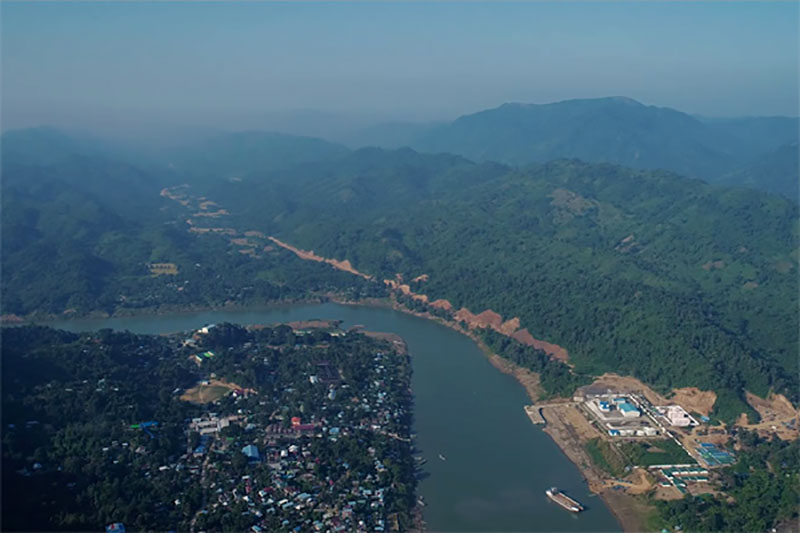
Paletwa, Chin State — Multiple Chin organizations have strongly opposed the Arakan Army’s (AA) recent decision to upgrade Paletwa Township in southern Chin State to district status under its administration.
The opposition comes after AA spokesperson Khaing Thukha announced during the 10th press conference of the Arakan People’s Revolutionary Government on 11 August that Paletwa would be upgraded following its capture from the junta during Operation 1027. The AA described Paletwa as the first liberated area on the western front and said its administration was overseeing stability, law enforcement, development, healthcare, education, and public services.
“During this revolutionary period, just because they captured it and defeated the junta, claiming ‘this is our territory’ is absolutely unacceptable. There is no unity in the current union yet, and further diplomatic discussions will be needed once the military dictatorship collapses,” said a spokesperson for the Interim Khumi Affairs Coordination Council (IKACC).
Chin State is still contested, with junta forces remaining in parts of the region. Differences also persist among Chin revolutionary groups, including the Chinland Council (CC) and Chin Brotherhood (CB). While the CC has formed a Chin government, it has not yet designated towns, townships, or districts.
The spokesperson emphasized that the future governance of Chin State is a matter solely for the Chin people. Although Paletwa is part of Chin State, both Rakhine and Chin communities live there, and coexistence has been traditionally accepted. With roughly 100,000 Chin people residing in Rakhine State, the issue will require negotiation in the future.
The Chin Civic Movement (CCM), a coalition of local and international youth, women, and intellectuals working to resolve internal differences, also rejected the ULA/AA’s administration in Paletwa in a statement on 12 August. While the CCM supports military actions aimed at overthrowing dictators and liberating oppressed ethnic groups, it described the AA’s unilateral governance—without local consent—as a colonial act against the Chin people.
“Unity and cooperation among Chin revolutionary groups are the only sustainable solution for Chin national affairs and building Chin State. The Paletwa issue can be renegotiated among stakeholders in a federal democratic manner after the people’s revolution,” the CCM statement said.
A representative of the Chin National Front (CNF) told Mizzima: “Just as Rakhine State should be governed by Rakhine people, Chin State should be governed by Chin people.”
The Global Khumi Organization (GKO) and Global Khumi Youth Association (GKYA) jointly issued a statement on 12 August rejecting the AA’s governance in Paletwa. They argued that the AA’s actions violate the Panglong Agreement, the territorial boundaries of Chin State as established by Myanmar’s constitutions, and the will of the entire Chin population, framing it as a power-centric, colonial-style system contrary to democratic principles.
Since the Arakan Army assumed control of Paletwa Township on 14 January 2024, local human rights records indicate six murders and five rape cases have occurred within one year. Despite the imposition of severe punishments, including the death penalty, residents have called for greater transparency in how the Arakan People’s Revolutionary Government has addressed these incidents.
Mizzima has sought comment from ULA/AA spokesperson Khaing Thukha regarding the opposition from Chin groups to the AA’s district designation and administration of Paletwa, but has not received a response.
In addition to the AA, allied with the Chin Brotherhood, members of the Chinland Defence Force-Paletwa (CDF-Paletwa) and Chin Defence Force-Daai (CDF-Daai), both part of the Chinland Council (CC), are also present and active in the township.