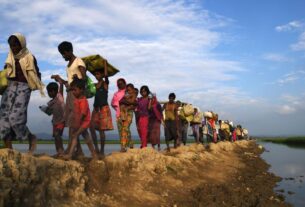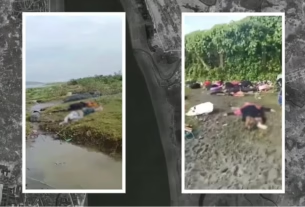
Years after the mass exodus of Rohingya people from Myanmar, the crisis stands as one of the clearest examples of the global failure of justice. Although Myanmar is bound by the Geneva Conventions, customary international humanitarian law norms, and the Genocide Convention of 1948, the Rohingya people are still deprived of justice, safety, and a viable path to return home. The problem, therefore, lies not in the absence of legal rules, but in the absence of principled enforcement.
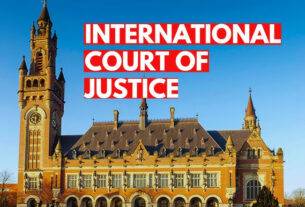
International courts have played a role, although lacking effects. In response to the Gambia’s allegation against Myanmar, the International Court of Justice (ICJ) ordered temporary measures in 2020 to stop the genocide and protect evidence. However, the orders remain largely symbolic as military operations are still ongoing in Rakhine State, humanitarian access is limited, and there is no real accountability in sight. Although the ICJ has moral and legal authority, it has limited enforcement mechanism. Consequently, its decisions could end up being nothing more than formal condemnations.
The International Criminal Court (ICC) suffers from similar limitations. However, in 2018, it was decided that the ICC can deal with crimes that cross borders to a signatory State, like that of the forced deportation of Rohingya people to Bangladesh (although Myanmar is not a signatory to the Rome Statute). While this has allowed an investigation to proceed, it does not address the full scale of atrocities committed within Myanmar. Eventually, arrests remain impossible without cooperation from the very same authorities accused of the crimes. As a result, justice delayed, in this context, increasingly resembles justice denied.
Furthermore, geopolitics has further weakened enforcement. China and Russia have repeatedly protected Myanmar from strong actions by the UN Security Council using their veto powers. On the other hand, ASEAN’s long-standing policy of non-interference has led to careful diplomacy instead of holding the states accountable. As a result, most of ASEAN’s work is still symbolic, with little or no effect to stop the mass atrocities. This paralysis exposes a harsh reality: international humanitarian law depends both on legal obligation and on political will.
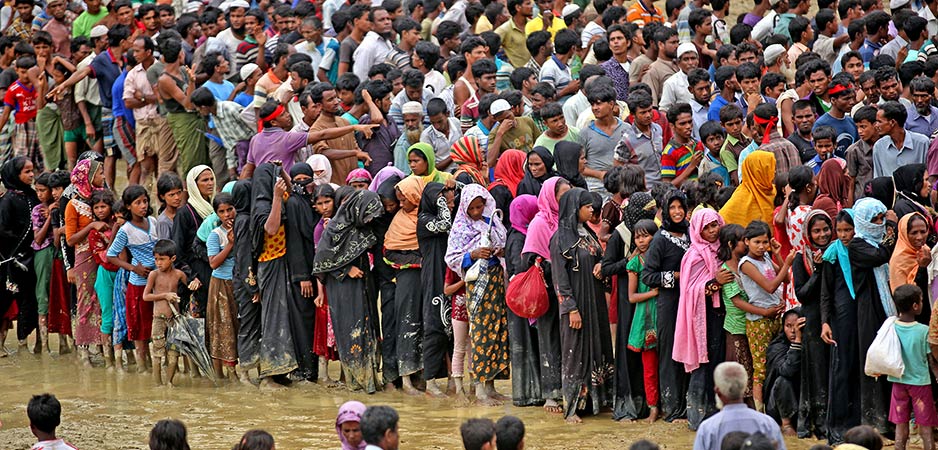
The consequences of this failure are borne most heavily (and disproportionately) by Bangladesh. The conditions for more than a million Rohingya refugees in Cox’s Bazar and Bhasan Char are increasingly deteriorating. The scarcity of funds has resulted in reduced food rations, limited educational opportunities, and overburdened health services. Moreover, donor fatigue has made an already fragile humanitarian situation even more vulnerable. On the other hand, the lack of accountability in Myanmar makes safe, voluntary, and dignified return rather impossible.
If the world really cares about justice, it needs to stop responding in bits and pieces and start working together. Bangladesh, willing ASEAN members, and relevant UN bodies could all support a regional system for collecting and documenting evidence. This could help keep the evidence safe and protect the witnesses, even if Myanmar remains unwilling to cooperate. Justice should not rely on the acquiescence of alleged offenders.
At the same time, sanctions need to be clear and impactful as well. While individual national measures have little effect, a unified sanctions regime aimed at military leaders, military-owned businesses, and arms transfers would put real pressure on them. Trade privileges and development cooperation ought to be explicitly contingent upon demonstrable adherence to international court directives. Similarly, ASEAN must also reflect on its actions. The principle of non-intervention should not equate to lack of responsibility. Establishing a regional framework that aligns humanitarian access with accountability will eventually strengthen ASEAN’s credibility.
Indeed, as of 2026, the Rohingya crisis shows a dangerous schism between law and reality. International humanitarian law is well developed, but it fails when political interests trump accountability. Closing this gap is not only a legal imperative but also a moral one. For the Rohingya people, justice delayed is a lived experience in overcrowded camps, through uncertain futures and broken promises. The world must now decide whether international law will remain a statement of principles or finally become a tool that delivers justice.
The writer teaches law at the European University of Bangladesh.