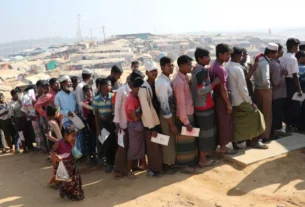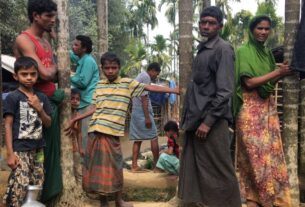
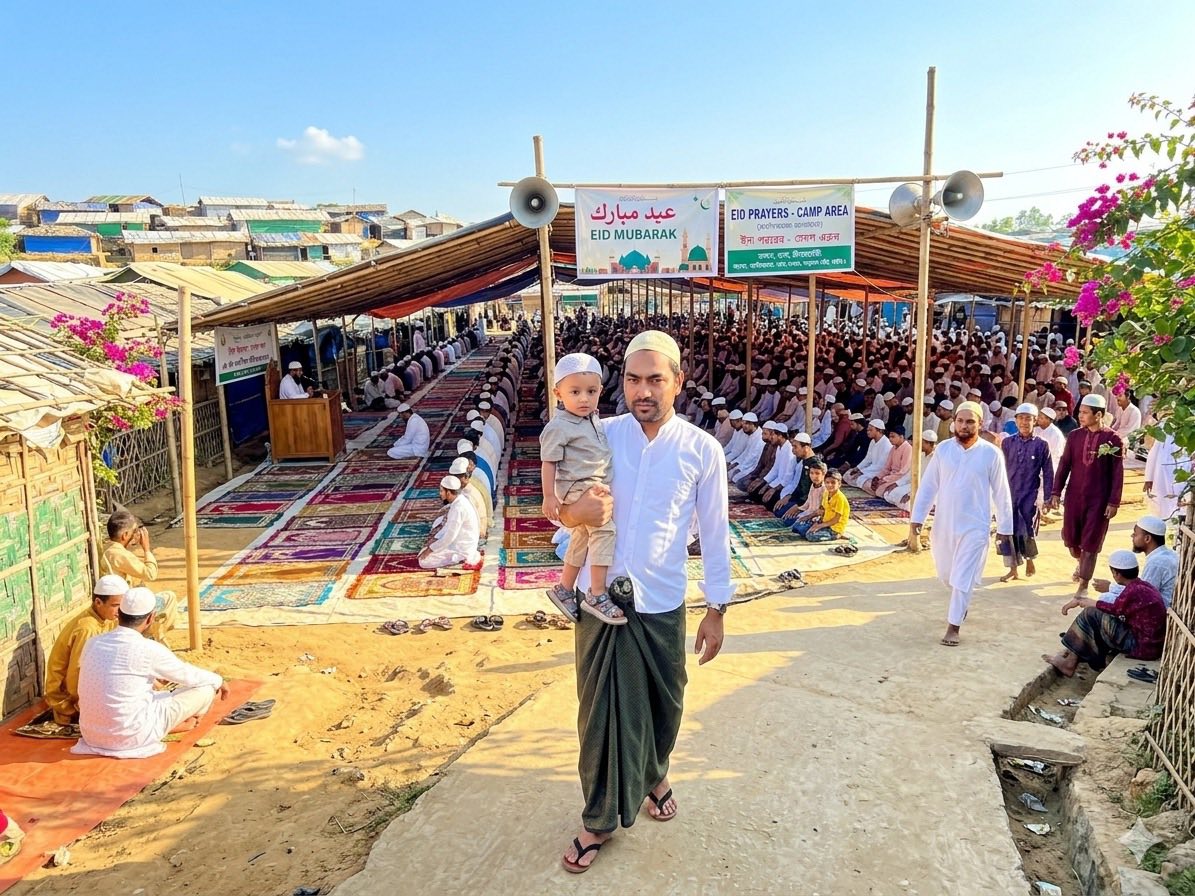
After the Eid congregation, they broke down in tears during the Munajat. In their prayers, they sought justice from Allah for the persecution they faced and pleaded to return to their own country
Two months ago, Cheno Ara Begum gave birth to a son in the Madhurchhara Rohingya camp in Ukhia, Cox’s Bazar.
On this, her son’s first Eid, she could not afford to buy him new clothes. Last year, on the first day of Holy Eid-ul-Fitr, she ate cooked beef with rice flour bread. This year, that was not in her fate.
For the past few years, her Eids have been spent in the Rohingya camps. Having fled Rakhine to save her life, Cheno Ara now has to share the joy of Eid with many other Rohingya refugees like herself. To her, however, the joy of Eid is now a memory of a past life.
She believes that since leaving their own country and coming to the refugee camps, their Eid festivities have become dull.
Countless refugees in other Rohingya camps face the same situation.
Cheno Ara Begum said: “I have five other daughters in my house. My only son was born two months ago. I couldn’t buy anything for any of my children for Eid. In Myanmar, my husband Abdul Hashem had a three-story wooden house. We also had a shrimp farm on three acres of land. Having lost all that, we now have to live in a shanty. On last year’s Eid, I gave every child new clothes. But since coming to this side, I haven’t been able to regularly arrange food for them. How can I buy new clothes?”
In the Leda camp of Teknaf and the Kutupalong, Lombashia, Balukhali, and Hakimpara camps of Ukhia, children were seen joining in the Eid joy since morning.
Young men set out for the mosques wearing new panjabis, lungis, and caps.
In some families, arrangements of vermicelli (semai) and cakes (pitha) were seen for entertaining guests.
However, while the joy of children was visible in some camps, the adults spent the day of Eid in sadness.
At 8:00 AM on Saturday, the Rohingya performed Eid prayers in the camps of Ukhia and Teknaf.
However, due to poverty and hardship, the colors of the Eid festival were faded to them.
After the Eid congregation, they broke down in tears during the Munajat. In their prayers, they sought justice from Allah for the persecution they faced and pleaded to return to their own country.
Syed Alam, a resident of the new Mouchoni Rohingya camp in Teknaf, told Dhaka Tribune: “Given the condition of our living and food situation, there is no scope to even think about Eid. There is no proper water system. There are no proper bathroom facilities. In this situation, no difference can be made between the day of Eid and an ordinary day. I couldn’t buy clothes for my children due to a lack of money. Food for the stomach comes first. Only if we can buy food can there be Eid joy.”
The Rohingya say that having been displaced from Myanmar, they have been spending painful Eids in crowded shanties in Bangladesh for nine consecutive years.
Even on this day of joy and festival, there is no peace. They are living through sorrow, hardship, uncertainty, and the wait to return to their own land. Since leaving their country, their Eid festival has become dull.
However, for the children, mini-fairs featuring ferris wheels and merry-go-rounds have been organized in several places, including Leda-Jadimora in Teknaf.
Nur Kamal, the organizer of the fair, said: “This fair will last for three days. The children are coming here and enjoying themselves very much.”