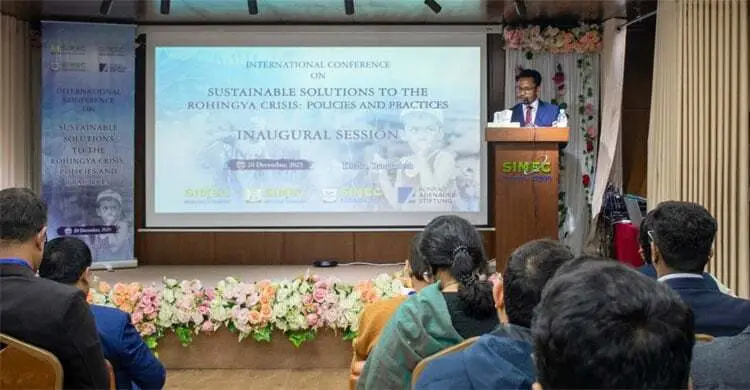
An international conference held in Dhaka today underscored the urgency of pursuing sustainable, rights-based, and politically informed solutions to the protracted Rohingya crisis, with speakers stressing that repatriation to Myanmar remains the only viable long-term option.
Speaking at the inaugural session, Abu Saleh Mohammed Obaidullah, Additional Refugee Relief and Repatriation Commissioner (Joint Secretary) at the Office of the RRRC in Cox’s Bazar, said the solution to the Rohingya crisis ultimately lies in Myanmar.
“Among the three classical solutions, only repatriation remains sustainable. Repatriation of the Rohingya must take place today or tomorrow, although it appears difficult now,” he said.
The conference, titled “Sustainable Solutions to the Rohingya Crisis: Policies and Practices,” was held at the SIMEC Institute of Technology in Uttara. It was jointly organised by the SIMEC Research Centre, Singapore, and the SIMEC Institute of Technology, Bangladesh, said a press release.
Obaidullah noted that Bangladesh is not in a position to locally integrate the Rohingya population, while resettlement opportunities remain extremely limited. “So far, only about 5,500 Rohingyas have been resettled. The changing international political landscape, marked by rising anti-migrant and anti-refugee sentiment, has made resettlement prospects increasingly bleak,” he added.
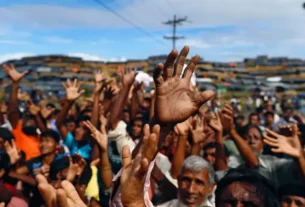
Rohingya representatives, who joined the conference virtually from refugee camps in Bangladesh, reiterated their desire to return to their homeland in Arakan, Myanmar. They emphasised the need for recognition of their identity and restoration of citizenship rights as prerequisites for any repatriation process.
Addressing a plenary session on digital intervention, Astrid Castelein, Assistant Representative for Protection at UNHCR Bangladesh, highlighted the importance of biometric registration and data protection in managing refugee assistance and pursuing durable solutions. She said digital data registration plays a critical role not only in humanitarian response but also in long-term planning. UNHCR began biometric registration of Rohingya refugees in Bangladesh in 2018 under a joint memorandum of understanding, she noted.
In his concluding remarks, Dr Imtiaz Ahmed stressed the need for regional cooperation, international responsibility-sharing, and justice-oriented approaches to address the crisis comprehensively.
He called for a broader understanding of the crisis by recognising the roles of multiple actors, including the Myanmar state and military, intergovernmental organisations, business communities, and civil society, to foster shared responsibility and accountability.
Engr Sardar Md Shaheen, Founder Chairman of the SIMEC Foundation and chief guest at the closing session, urged Bangladeshi academicians and research institutions to continue producing policy-relevant scholarship. He said sustained academic engagement is essential to finding durable solutions to a crisis that has placed significant social, economic, and environmental strain on Bangladesh.
The conference brought together scholars, policymakers, humanitarian practitioners, Rohingya representatives, media professionals, and government officials from Bangladesh, the United States, Singapore, Germany, and India. Participants collectively highlighted the limitations of short-term humanitarian approaches and called for urgent action toward sustainable and rights-based solutions to the Rohingya crisis.