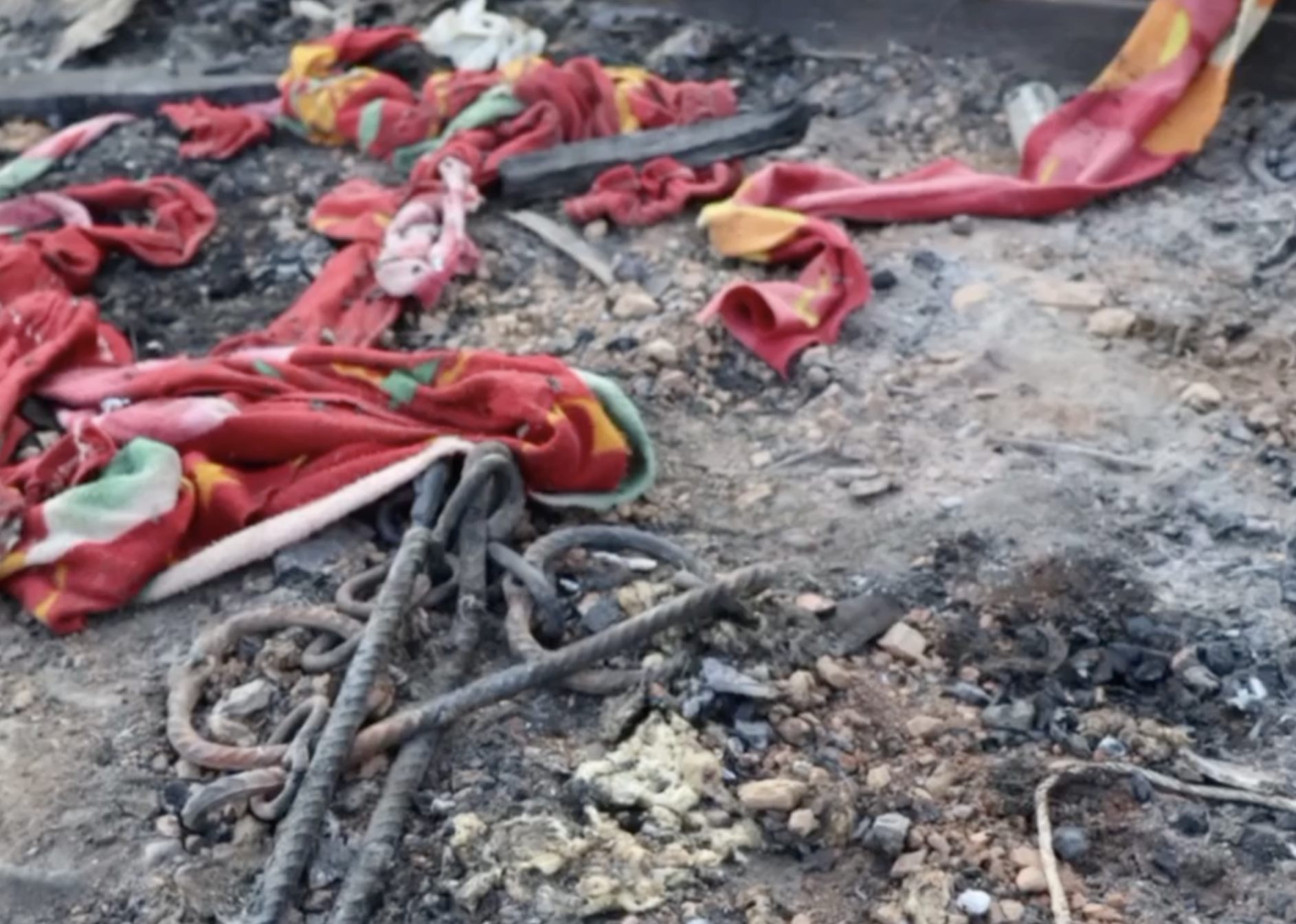
On March 8, four Myanmar military jet fighters and four Y-12 aircraft carried out one of the deadliest airstrikes of the Rakhine war, launching repeated bombing runs for more than three hours. The target was not a frontline base, a moving convoy, or an active battlefield. It was a detention camp in the Darlatchaung area of Ann Township holding prisoners of war.
By the Arakan Army’s preliminary count, the attack killed 116 prisoners of war and detainees and injured 32 others, with many more wounded. Among the dead were senior officers, including Brigadier General Myint Shwe, along with several majors and military medical personnel. Some civilians serving prison sentences were also reportedly killed in the strike.
If confirmed, the Ann airstrike may be remembered as one of the most disturbing moments in Myanmar’s modern history: a military appears to have bombed a detention site in the full knowledge that it contained its own captured soldiers.
This incident raises a stark question about the nature of the Rakhine conflict: what happens when even surrendered troops are no longer safe from the sky?
The meaning of the Ann strike
War is brutal, but it is conducted under globally recognized rules.
Under international humanitarian law, including the Geneva Conventions, prisoners of war are protected persons. Once soldiers surrender and are detained, they are no longer lawful military targets. Their protection is a fundamental norm governing armed conflict.
That is what makes the Ann strike so alarming.
According to the testimony of Brigadier General Thaung Tun, the captured deputy commander of the Western Regional Military Command, the regime had conducted prior reconnaissance flights. He stated the compound was clearly recognizable as a prison facility from the air, with organized buildings, guard posts, and detainees wearing prison uniforms.
As such, the attack cannot easily be explained as confusion or battlefield misidentification.
Instead, it suggests a deliberate strike against the military’s own captured personnel.
A growing pattern
The Ann incident does not stand alone.
Over the past two years, several airstrikes have reportedly hit locations where Arakan Army-captured soldiers were being held.
According to the Rakhine-based Development Media Group (DMG), six aerial attacks on detention sites since 2024 have killed 226 prisoners of war and family members and injured 93 others.
They include:
September 9, 2024: Shin Ywar camp in Pauktaw Township and Border Guard Police Battalion No. 2 in Maungdaw Township
January 18, 2025: Ram Chaung camp in Mrauk-U Township
February 28, 2025: Border Guard Police Battalion site in Maungdaw
January 20, 2026: Chaung Tu camp on the Kyauktaw-Ponnagyun border
March 8, 2026: Darlatchaung camp in Ann Township
These strikes occurred in locations that were not active battlefields at the time.
While one strike might be explained as the “fog of war”, six similar incidents suggest a darker logic: a military that views captured soldiers as expendable liabilities rather than comrades to be recovered.
War from the sky
Over the past two years, the United League of Arakan/Arakan Army (ULA/AA) has seized 14 of Rakhine State’s 17 townships, capturing major towns and military installations. As the junta’s ground presence has collapsed, its reliance on airpower has grown.
Airstrikes have become the regime’s primary tool for projecting force into areas it no longer governs. Villages, schools, hospitals, and displacement camps have been bombed, as the battle shifts from direct combat to aerial punishment.
Seen through this lens, the bombing of detention camps may reflect a grim logic: if the military cannot recover captured soldiers or reassert control over territory, it can exterminate them from the air to send a message to frontline troops that surrender is not an option.
The collapse of military trust
The most striking aspect of the Ann bombing is that the strongest criticism came from captured soldiers themselves.
“This kind of action is a betrayal,” said Sergeant Major Thein Lwin, who served in the Myanmar military for 34 years and survived the attack. “We were no longer armed. We were prisoners. Why did they do this to us?”
Another survivor, Aung Myo Myat, a former artillery officer, recalled the moment the bombs began to fall.
He said he never imagined that fighter jets from his own military would attack a detention site where their captured soldiers were being held. As explosions ripped through the compound, detainees trapped inside burning prison blocks screamed for help.
The shock, he said, was not only the violence of the attack but the realization that it came from the very institution they had once served.
Brig-Gen Kyaw Kyaw Than, the former chief of staff of the Western Regional Military Command, said that the continued bombing of POWs suggests the military leadership has effectively abandoned its captured men.
Such statements strike at the core of what binds an army together.
Military institutions depend not only on command structures and weapons but on trust—trust that commanders value the lives of their soldiers, and that surrender does not mean abandonment.
If soldiers believe that capture makes them expendable, the consequences can ripple across the battlefield. Some may fight more desperately, fearing captivity. Others may lose confidence in the institution they serve.
Either outcome makes war more brutal.
A devastating contrast
The political narrative is further complicated by survivor testimony that Arakan Army personnel broke open prison doors to rescue detainees while bombs were still falling.
Such accounts must always be read cautiously in wartime. Yet if even part of them proves accurate, the contrast is stark.
A military that claims to defend the nation is accused by its own captured soldiers of abandoning them. Meanwhile, the enemy is described as rescuing prisoners during the attack.
In any conflict, such reversals can be politically devastating.
The human cost
The victims in Ann were human beings—many of whom had already survived battles, surrender, and captivity—only to be burned beyond recognition, leaving families unable to identify the dead.
For the relatives of the missing, the tragedy is not abstract. It is deeply personal.
As Daw Thida Soe, the wife of one missing prisoner, put it: it feels as though these men were exploited for battle and then discarded when they were no longer useful.
A warning for the future
The bombing of the Ann detention camp signals a new phase in the war in Rakhine, one in which the rules of war are eroding even further.
The conflict has already crossed many lines: the bombing of hospitals, the destruction of schools, and repeated airstrikes on civilian communities.
If prisoners of war are now also becoming targets, then one of the last restraints of war is disappearing.
And when even captivity no longer offers protection, the war risks becoming something far more dangerous not only for civilians, but for soldiers themselves.
The question now is whether the international community will recognize the significance of the Ann strike before it sets a standard for Myanmar’s wider conflict.