Fortify Rights calls on Thailand to protect Rohingya refugees abandoned at sea by India
On 8 April, Fortify Rights called on Thailand to provide legal status and support third-country resettlement for 36 Rohingya refugees who arrived in the country in February, after Indian authorities forcibly returned them to Myanmar ten months earlier.
“Rohingya refugees are being pushed from one danger to another, and no one should have to live like this,” said Puttanee Kangkun, Director at Fortify Rights. “Governments in the region must stop forcing refugees into harm and instead ensure coordinated, lawful pathways to protection that respect their human rights and dignity. We are ready to support them in this.”
In February 2026, Fortify Rights interviewed 14 Rohingya survivors from the group of 40 Rohingya—both Christian and Muslim—who reached Thailand that month after Indian authorities forcibly returned them to Myanmar from New Delhi, India, approximately ten months ago. The whereabouts of four of the 40 survivors are unknown, according to Fortify Rights. All hold refugee cards issued by the U.N. High Commissioner for Refugees (UNHCR)—the U.N. agency mandated to protect refugees.
Fortify Rights is withholding the identities of survivors and using pseudonyms to protect them from retaliation.
In May 2025, under the pretext of a routine biometric verification exercise for refugees, New Delhi police detained Rohingya men and women, flew them to a remote island in the Andaman Sea, equipped them with life jackets, and abandoned them at sea near Myanmar, where they face an ongoing genocide, war crimes, and crimes against humanity. The group— ranging in age between 21 and 60 and including 11 women—then spent several months in an armed-conflict zone in Myanmar’s Tanintharyi Region before fleeing to Thailand in February 2026.
The U.N. Special Rapporteur on human rights in Myanmar, Tom Andrews, referred to India’s actions as “unconscionable, unacceptable acts” and presented evidence of the allegations to the Government of India in May 2025. The BBC, Associated Press, and others also reported on the situation.
“Laila,” a 24-year-old Rohingya Christian woman, told Fortify Rights that Indian police verbally harassed her and other women during the February 2025 biometric verification exercise. “He asked intrusive and humiliating questions, including: ‘How did your husband treat you sexually? Did he force you to have sex with him?’ I felt dehumanized,” said Laila.
Another 21-year-old Rohingya Christian woman, “Sabika,” shared a similar experience, saying Indian officials used degrading language during the biometric verification exercise.
Indian authorities later arrested, detained, and interrogated Rohingya refugees at Dwarka District Police Station in Uttam Nagar, a suburb in New Delhi, before initiating their refoulement. Sabika said:
The police forced us into a crowded police van with black-curtain-covered windows that brought us to the airport, where we boarded an Air India plane with only 40 of us. After four hours in the air, we landed at a naval facility, as the Navy had accompanied us. It is an island. I don’t know the exact name of the place, but I heard it is in the Nicobar Islands.
At the Navy facility, Indian Navy personnel handcuffed and blindfolded the Rohingya men. Several men also reported to Fortify Rights that Navy personnel beat them. For example, a 23-year-old Rohingya man, “Amjad” told Fortify Rights:
The Navy personnel hit other men and me. They hit me on the head and body when I couldn’t answer their questions. When I asked for water, one of the Navy officers shouted at me, “Why don’t you follow the instructions?” and beat me again. They stuffed cloth in my mouth. When someone asked for a toilet or anything, the Navy personnel hit them. I saw three other young men beaten badly.
Indian Navy personnel also sexually assaulted some Rohingya women in detention. Laila told Fortify Rights: “A naval officer groped my body. I cried a lot. This incident has stuck in my mind for days and months. I have never faced such harassment. I can never forget it.”
On May 7, 2025, around 2 a.m., the Indian Navy confiscated most of the refugees’ mobile phones and documents, including their UNHCR cards, gave them life jackets, and loaded them into two small boats, telling them that they would be taken to Indonesia. The Navy officers accompanied the two motorboats carrying the refugees, each carrying approximately 20 people.
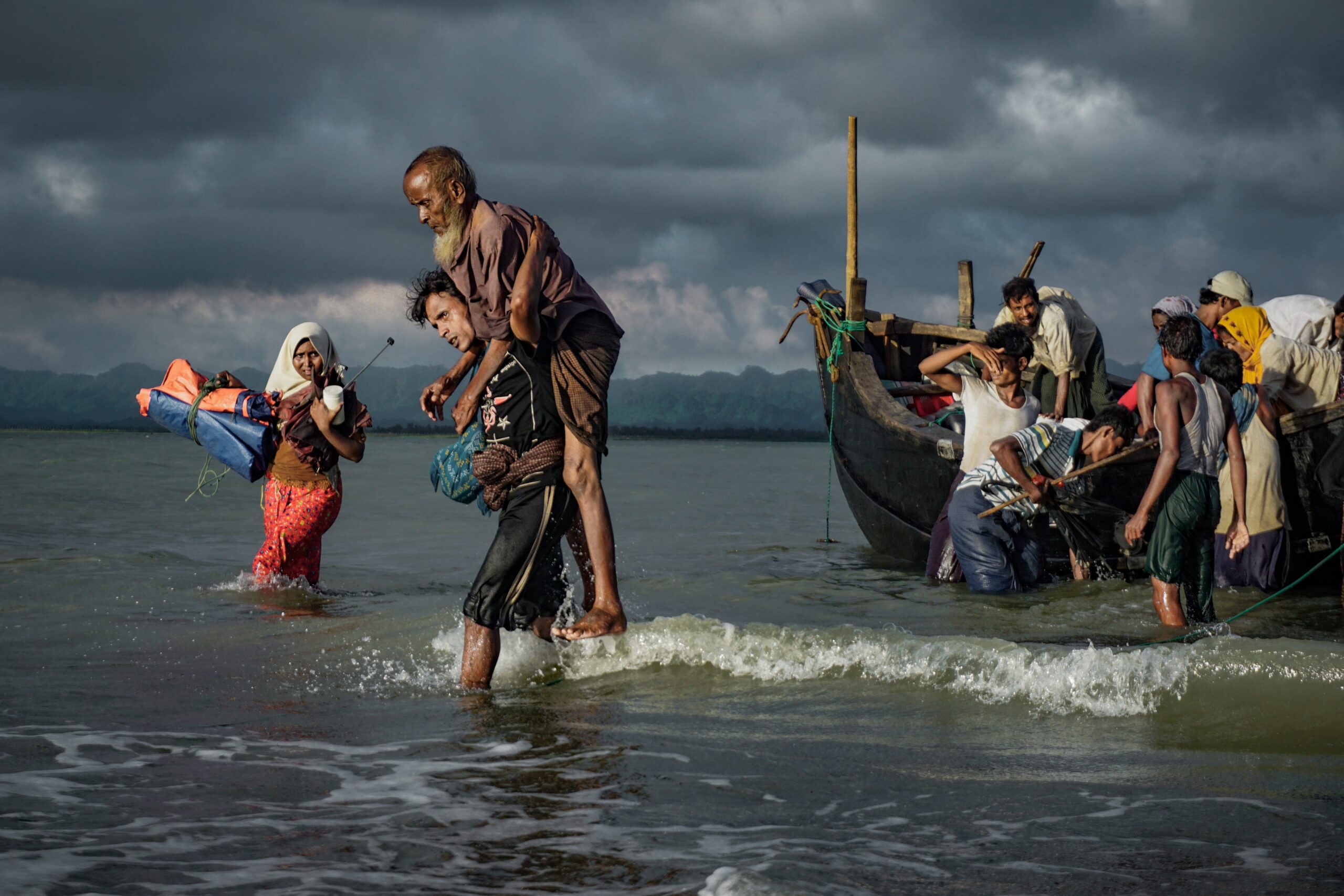
After reaching the Myanmar shoreline, Indian Navy personnel tied a rope from a tree to the boats and forced the refugees into the sea, leaving them to pull themselves to shore.
“I did not know where we were,” Harres, a 60-year-old woman, told Fortify Rights. “Some of us were able to keep our mobile phones, and when we turned them on, we received a text message in Burmese. Then, we realized we were in Myanmar territory.”
The refugees later discovered they had landed on the mainland in Dawei, Tanintharyi Region, Myanmar—a site of heavy armed conflict between the Myanmar military junta and People’s Defense Forces (PDFs). Local fishermen assisted the group in reaching territory controlled by the local PDF group, where they remained for approximately nine months amid active armed conflict. The refugees reported that the group had taken good and appropriate care of them; however, the area is an active war zone and unsafe.
Romiz, a 22-year-old Christian Rohingya man, told Fortify Rights:
The PDF unit instructed us to move from place to place during the fighting. We heard of the fighting and sometimes the jet sounds. The PDF informed us that the Myanmar military would kill us if they found us. We had to keep hiding. It was scary. The situation worsened during the monsoon season. Our shelters were temporary, a kind of tarpaulin material. It is wet and difficult to live.
Fearing the regular aerial bombardments and shelling by the Myanmar military junta and unable to safely relocate within Myanmar due to the ongoing genocide and war crimes against the Rohingya, the group fled to Thailand.
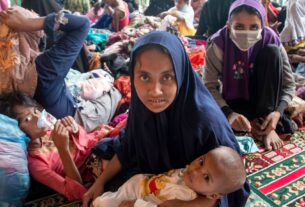
The 40 refugees arrived in Thailand in February 2026, and 36 of them are now in an undisclosed location.
All survivors said they cannot return to Rakhine State due to decades of persecution, discrimination, and violence. They described land confiscations, forced labor, torture, segregation, and religious persecution at the hands of Myanmar authorities. Many fled as children or young adults, first to Bangladesh and later to India.
More than one million Rohingya refugees, many of whom fled genocidal attacks by the Myanmar military in 2016 and 2017, live in overcrowded refugee camps in Cox’s Bazar District, Bangladesh. Several hundred thousand live in Southeast Asia, primarily in Malaysia, Thailand, and Indonesia. An estimated 500,000 Rohingya remain in Rakhine State, Myanmar, and continue to face genocide and other international crimes as well as restrictions on basic rights, including freedom of movement and equal access to full citizenship rights.
In January this year, the International Court of Justice in The Hague held public hearings in The Gambia v. Myanmar, a landmark case under the 1948 Genocide Convention alleging that Myanmar committed genocide against the Rohingya people in Rakhine State. A verdict is expected later this year.
Thailand does not recognize refugees and provides few protections to them, routinely subjecting them to arrest, detention, exploitation, and refoulement. UNHCR confirmed to Fortify Rights that the agency does not have permission to facilitate a refugee determination process for these newly arrived Rohingya refugees.
In 2019, the Thai government endorsed the National Screening Mechanism (NSM) to screen and protect persons who fled persecution in their home country. However, Rohingya are arbitrarily excluded from the NSM on broadly defined “national security” grounds. Since October 2024, Thai authorities have only granted protected status to seven individuals, despite an estimated tens of thousands of refugees and asylum seekers in Thailand who could qualify for screening and protection under the NSM.
Under Thailand’s 1979 Immigration Act, undocumented persons found in Thailand, including those recognized by UNHCR as refugees and holding UNHCR refugee cards, are considered in violation of the Act and subject to arbitrary arrest and detention.
Although Thailand enacted the Prevention and Suppression of Torture and Enforced Disappearance Act in October 2022, which prohibits refoulement —the forced return of a person to a country where they face a real risk of torture or other serious harm— Fortify Rights continues to document Thai authorities forcibly returning refugees to places where they face a high risk of such harm.
Moreover, returning Rohingya refugees to Myanmar, where they face genocidal violence and ongoing armed conflict, violates the general principle of non-refoulement, which is binding on all states as part of customary international law.
“These Rohingya survivors were unlawfully forced back into a conflict zone and are now left without protection,” said Puttanee Kangkun. “India should investigate and hold to account officials involved in any and all forced returns and abuse of refugees. Thailand has an obligation to protect these and all refugees from arbitrary arrest and refoulement.”