
The global energy crisis has hit Myanmar with rising fuel prices and shortages, but one economic expert warns that the military regime in Naypyidaw’s deeply entrenched financial policies are the true, lasting drivers of the country’s humanitarian disaster.
Development economist Jared Bissinger spoke to DVB about how external shocks are colliding with the regime’s mismanagement, leaving millions of civilians to bear the brunt of an economy on the brink since a military coup five years ago, on Feb. 1, 2021.
“What Myanmar has experienced post-coup is really the effects of economic policies that have caused so much of the country’s economic decline,” Bissinger told DVB. “These aren’t policies that are going away… What you’re seeing in Myanmar now is the result of those policies.”
Military priorities amid fuel shortages
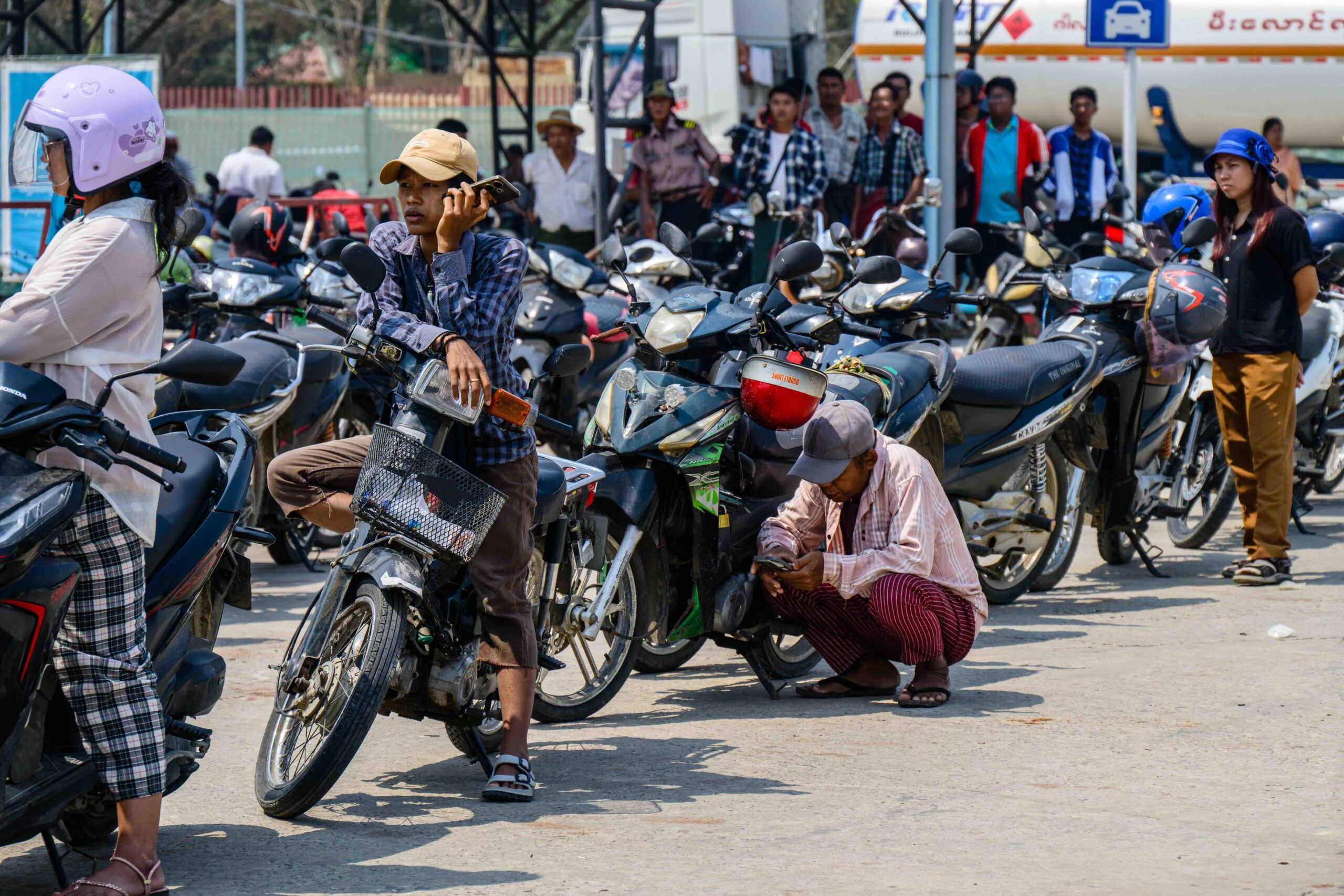
As the global supply of fuel tightens, Myanmar has become heavily dependent on importing it. All the while running a trade surplus. Transport costs have spiked, flights and bus routes are being canceled, and long queues at gas stations have become the norm.
In response, Naypyidaw has resorted to strict administrative controls rather than market solutions—implementing an “odd-even” driving system, QR codes, and mileage-based rationing. Meanwhile, the regime’s massive fiscal deficit leaves no room for public fuel subsidies.
Bissinger said that the regime’s response clearly highlights its priorities. The military controls the country’s financial and physical fuel infrastructure, including key depots around Yangon.
“They are going to and are prioritizing military use of fuel,” Bissinger told DVB. “If the military wants access, they get access. So it’s not a market-based system. It is very clearly a two-tier system… it means [civilians] get what’s left.”
Food insecurity and agricultural collapse
The energy shock means fertilizer prices have surged by roughly 80 per cent, hitting the agricultural sector hard. This price spike means Myanmar will have to import less or pay more to obtain the same amounts.
This comes on the heels of a difficult 2025 for Myanmar’s rice farmers, who already suffered low profits. Bissinger cited recent warnings from the World Food Programme (WFP), noting that a projected 50 per cent cut in fertilizer use could reduce rice yields by 10-15 per cent.
While higher global rice prices might eventually benefit some farmers, factory workers face a dire situation. Skyrocketing food prices, combined with supply chain disruptions and a lack of diesel to run factory generators, threaten to devastate the urban working class as wages aren’t rising fast enough.
The 2025 humanitarian needs and response plan for Myanmar had over 20 million people in need of humanitarian assistance, highlighted Bissinger, emphasizing that the fuel crisis will only deepen this severe food and job insecurity.
Poverty and currency manipulation
Beyond the immediate energy shock, Bissinger’s upcoming research points to deliberate regime policies that make poverty a natural outcome even in areas untouched by the ongoing civil war.
In regions like Yangon and Ayeyarwady, millions require humanitarian aid due almost entirely to economic controls. A prime example is the regime’s manipulation of the exchange rate, which means traders get fewer kyat for their crops.
By overvaluing the kyat, the regime is actively undermining the country’s export industries. This reduces the amount of foreign exchange into the official banking system and makes exports less competitive.
Traders are incentivized to keep some of their money outside of the country or try to send it via hundi—informal remittance networks relied upon by migrant workers–at a better rate, meaning less via official channels.
Furthermore, the regime has weaponized international financial standards to monopolize civilian wealth.
Under the guise of complying with the Financial Action Task Force (FATF) anti-money laundering regulations, Naypyidaw has severely cracked down on hundi even though in 2008 it noted that this traditional money transfer system was largely legitimate.
“The regime is doing this not because they want to address money laundering, but because they want to push everyone to use the official system and the banks so that they can get the foreign exchange coming into the country,” Bissinger told DVB.
Stay tuned to DVB English News for our upcoming Newsroom interview with Jared Bissinger, a visiting fellow with the Myanmar Studies Programme at the ISEAS – Yusof Ishak Institute and the research lead at Catalyst Economics.