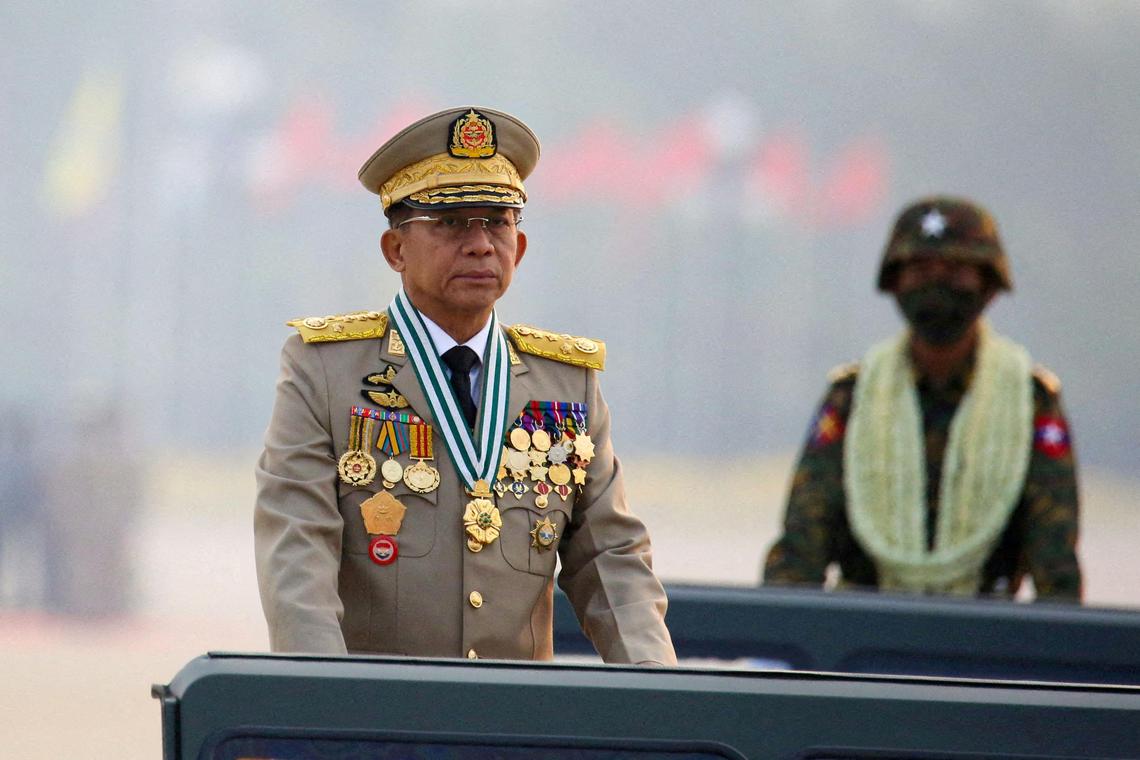
Myanmar junta leader Min Aung Hlang is accused by several rights groups of an escalating campaign to influence and intimidate members of the Association of Southeast Asian Nations (ASEAN) in an attempt to evade criminal accountability over human rights violations against the country’s citizens.
The Rohingya Maìyafuìnor Collaborative Network, the Chin Human Rights Organisation, and the Myanmar Accountability Project released a joint statement on 5 May condemn the actions of the junta in the strongest possible terms.
These efforts have included direct pressure on governments, interference in domestic legal processes, and coercive diplomatic actions. Of particular concern was the removal of Timorese diplomats in January, an act that signaled a clear attempt to exert political leverage over Timor-Leste at a critical moment, as legal proceedings related to international crimes were advancing.
At the core of this conduct lies a fundamental absurdity. A self-appointed regime, instituted without any political mandate or legitimacy, is attempting to act in the name of a sovereign state in order to shield individuals from criminal liability. The invocation of sovereignty in this context is not only legally flawed; it is an abuse of the very principle it seeks to rely upon.
This pattern reflects a broader strategy by the regime to shield itself behind the state, exploiting claims of official capacity to deflect individual criminal responsibility. More recently, this has been reinforced by an attempt to rebrand the military junta as a civilian administration, projecting a false image of legitimacy to gain diplomatic ground and weaken international resolve.
Under this manufactured facade, the regime has launched a coordinated campaign to pressure governments to disengage from ongoing legal cases. This includes attempts to interfere in the independent judicial processes of Timor-Leste and Indonesia, where cases against Min Aung Hlaing for genocide, war crimes, and crimes against humanity are currently under active consideration.
Such actions constitute a blatant attempt to pervert the course of justice and undermine the rule of law. They also represent an unacceptable intrusion into the internal affairs of ASEAN member states, threatening judicial independence and eroding regional norms.
The cases filed in Timor-Leste in January and in Indonesia in April are grounded in substantial and credible evidence. Submissions in Jakarta demonstrate that Min Aung Hlaing was the architect of the 2017 clearance operations against the Rohingya and that genocidal acts continue to this day. In Timor-Leste, evidence establishes command responsibility for acts including mass killings, sexual violence, attacks on civilians and religious institutions, and indiscriminate aerial bombardment.
The individual responsible for these crimes should face justice in a court of law, not seek refuge behind state institutions or diplomatic maneuvering.
We urge the governments of Timor-Leste and Indonesia to firmly reject any external pressure and uphold the independence of their judicial systems. We further call on all UN member states and ASEAN partners to resist this attempt to normalize impunity under the guise of diplomacy.
The regime’s so-called diplomatic offensive is not reform. It is obstruction. It must be rejected unequivocally.