Myanmar’s military-led government is accelerating efforts to revive the long-delayed No. 1 Steel Mill in Myingyan, Mandalay Region, as part of a broader strategy to strengthen domestic steel production and reduce dependence on imported steel products.
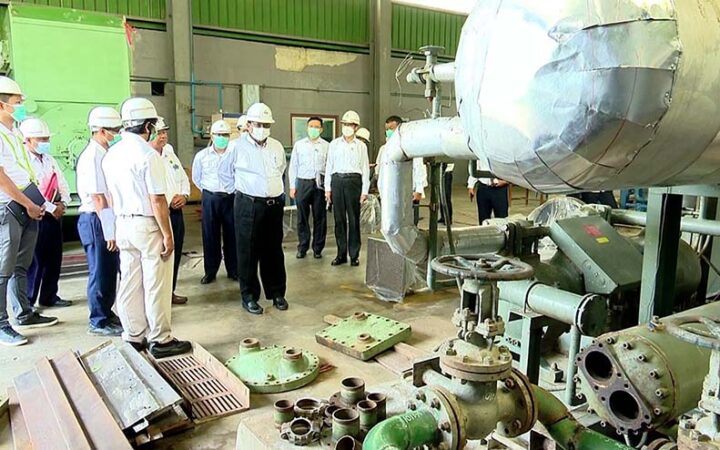
According to state media, Union Minister for Industry Dr. Charlie Than met with a team of Indian technical experts on 7 June at the Directorate of Industrial Supervision and Inspection in Mandalay Region. The discussions focused on machinery rehabilitation, technology transfer, workforce development, and the future operation of the steel complex.
The Ministry of Industry reported that Foundry No. 1 at the Myingyan steel complex resumed operations in March 2023 and has since produced more than 28,000 tonnes of steel billets. Officials also noted that Foundry No. 2 restarted production of steel slabs after extensive repairs carried out jointly by Indian and Myanmar specialists in early 2024.
During a separate meeting, Dr. Charlie Than emphasized the strategic importance of steel production for national development, highlighting its role in supporting infrastructure projects and industrial growth. He called for continued cooperation in technology transfer, skills development, and production planning, with authorities targeting an output of 200 tonnes of steel billets in the next phase of operations.
The Myingyan steel project, one of Myanmar’s most ambitious industrial ventures, was launched in the mid-2000s with the goal of producing up to 400,000 tonnes of steel and steel products annually. However, years of delays, technical challenges, and rising debt burdens led to the suspension of the project in 2017.
Following the military takeover in February 2021, Senior General Min Aung Hlaing has prioritized the revival of major state-owned heavy-industry projects, arguing that increased domestic steel production is essential for infrastructure development, industrial self-sufficiency, and reducing reliance on foreign imports.
However, economists and industry observers remain skeptical about the long-term viability of such large-scale industrial investments, citing Myanmar’s continuing economic difficulties, energy constraints, and ongoing armed conflicts.
The latest engagement with Indian experts reflects the junta’s continuing efforts to secure foreign technical assistance and move the Myingyan steel facility closer to full-scale commercial production, signaling renewed momentum behind one of Myanmar’s largest industrial projects.