The Arakan Army (AA) has been designated as a terrorist group by Myanmar’s military government as of September 2024.
In January 2019, Myanmar’s Anti-Terrorism Central Committee officially labeled the Arakan Army a terrorist organization under the country’s counter-terrorism law.
The Anti-Terrorism Central Committee has issued this notification by exercising the authority mentioned in Subsection (e) of Section 6 and Subsection (b) of Section 72 of the Counter-Terrorism Law, with the approval of the Union government.
1. The Anti-Terrorism Central Committee declared the United League of Arakan (ULA)/Arakan Army (AA) as a terrorist group under its notification 1/2020 dated 23 March 2020. However, the declaration against that terrorist group was revoked under notification of the central committee dated 11 March 2021 in order to restore durable peace nationwide in accord with the five-point roadmap and nine objectives adopted by the State Administration Council.
2. Currently, the United League of Arakan (ULA)/Arakan Army (AA) still commits terror acts mentioned in the Counter-Terrorism Law by harming public security and their life and property and violently causing loss and damage to essential infrastructures of individuals or public, State-owned buildings, vehicles, machinery, and accessories, including the violent acts to blow up public roads and bridges, explode electric towers, fire on populated towns and villages from a far distance with the use of heavy weapons, drop bombs, kill innocent people, forcibly recruit new members and destroy State-owned buildings, vehicles, machinery and equipment. Moreover, the group based in the country is committing terror acts against the State.
3. As such, the Anti-Terrorism Central Committee has cancelled the revocation of its declaration over the aforementioned group under notification 1/2021 dated 11 March 2021 and has declared the group as a terrorist group.
The designation was revoked in March 2021 in an effort to promote peace and align with the State Administration Council’s roadmap.
On September 2, 2024, Myanmar’s military government once again classified the Arakan Army—alongside the Ta’ang National Liberation Army (TNLA) and the Myanmar National Democratic Alliance Army (MNDAA)—as terrorist organizations. This move came after these groups made significant territorial advances in northern and western Myanmar.
Under Myanmar’s Anti-Terror Law, any contact with these groups is considered a criminal offense. The government has warned that individuals who communicate or collaborate with them may also be prosecuted for terrorism-related activities.
The Arakan Army is an ethnic Rakhine armed group that has been involved in conflict with Myanmar’s central government for years, advocating for greater autonomy in Rakhine State.
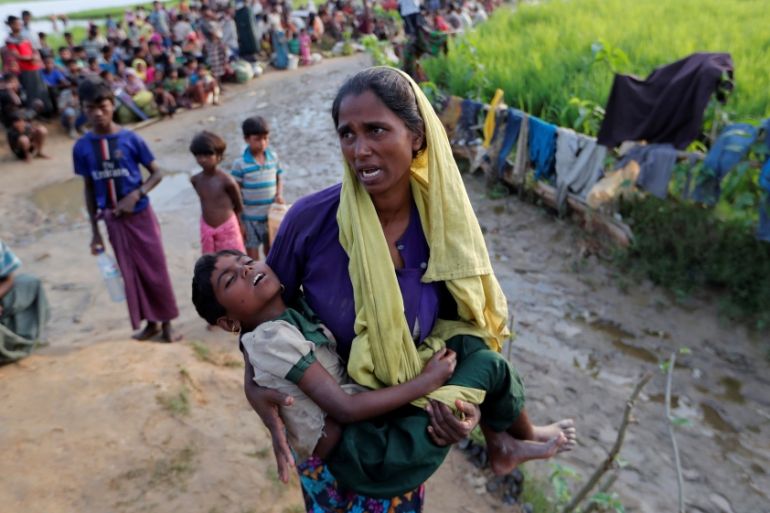
AA/ ULA and War crimes and atrocities
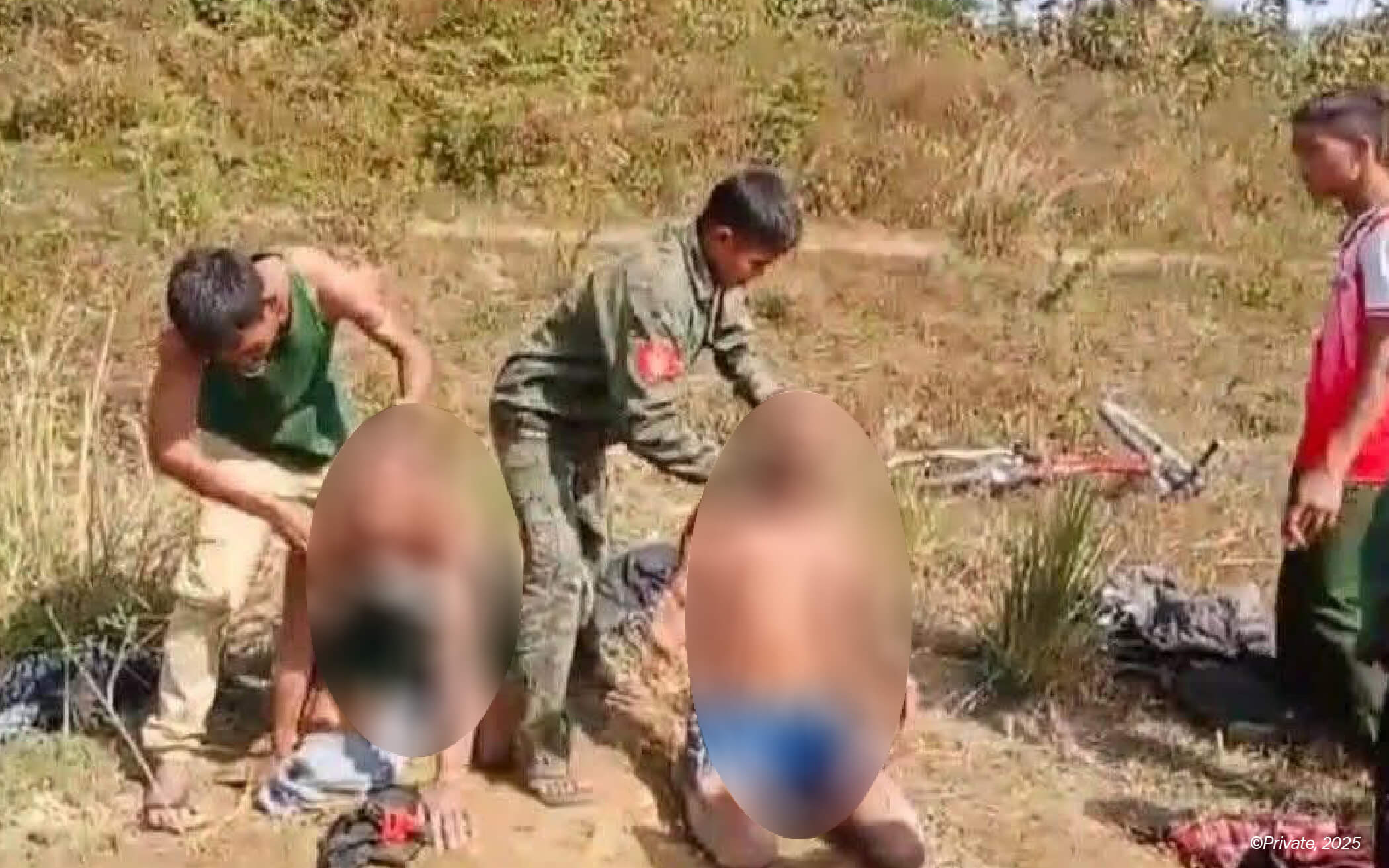
The Arakan Army (AA) has been accused of forcibly recruiting Rohingya people into its organisational structure and claiming to create an inclusive, federalist government to counter the Tatmadaw in Rakhine. Reports allege atrocities being carried out by the AA and the use of Rohingya people as cannon fodder and human shields. Other reports allege that the Junta had been exploiting tensions between the Arakanese and Rohingya by forcefully recruiting Rohingya people to be used as human shields and cannon fodders. AA has also been accused of targeted strikes against Rohingya civilians, particularly in a series of attacks in early August 2024 along the Myanmar-Bangladesh border when over a hundred Rohingya were killed. Witnesses reporting the intentional targeting of civilians with drones and artillery.
Evidence also surfaced in 2025 of a massacre in Htan Shauk Khan village, where AA soldiers are alleged to have killed at least 600 Rohingya and raped several women. AA spokesperson Khaing Thu Kha stated that the allegations were part of a smear campaign, citing the evidence presented showing that AA were striking junta.
Analyst David Scott Mathieson noted that conflicting accounts of incidents have caused confusion among international observers, which is exacerbated by the SAC’s recruitment of Rohingya men into its military. He stated that “multiple realities can exist at the same time: that AA forces can perpetrate atrocities at one location whilst also aiding civilians elsewhere. intent to destroy the Rohingya as an ethnic group.
Fortify Rights, an international human rights organization, documented atrocities committed by AA in 2024 through survivor testimonies, open-source videos, and photographs and called on the International Criminal Court (ICC) to investigate the AA’s actions as potential war crime. The organization’s report described how the evidence revealed the deliberate nature of the attacks, including the use of surveillance drones before launching offensives.
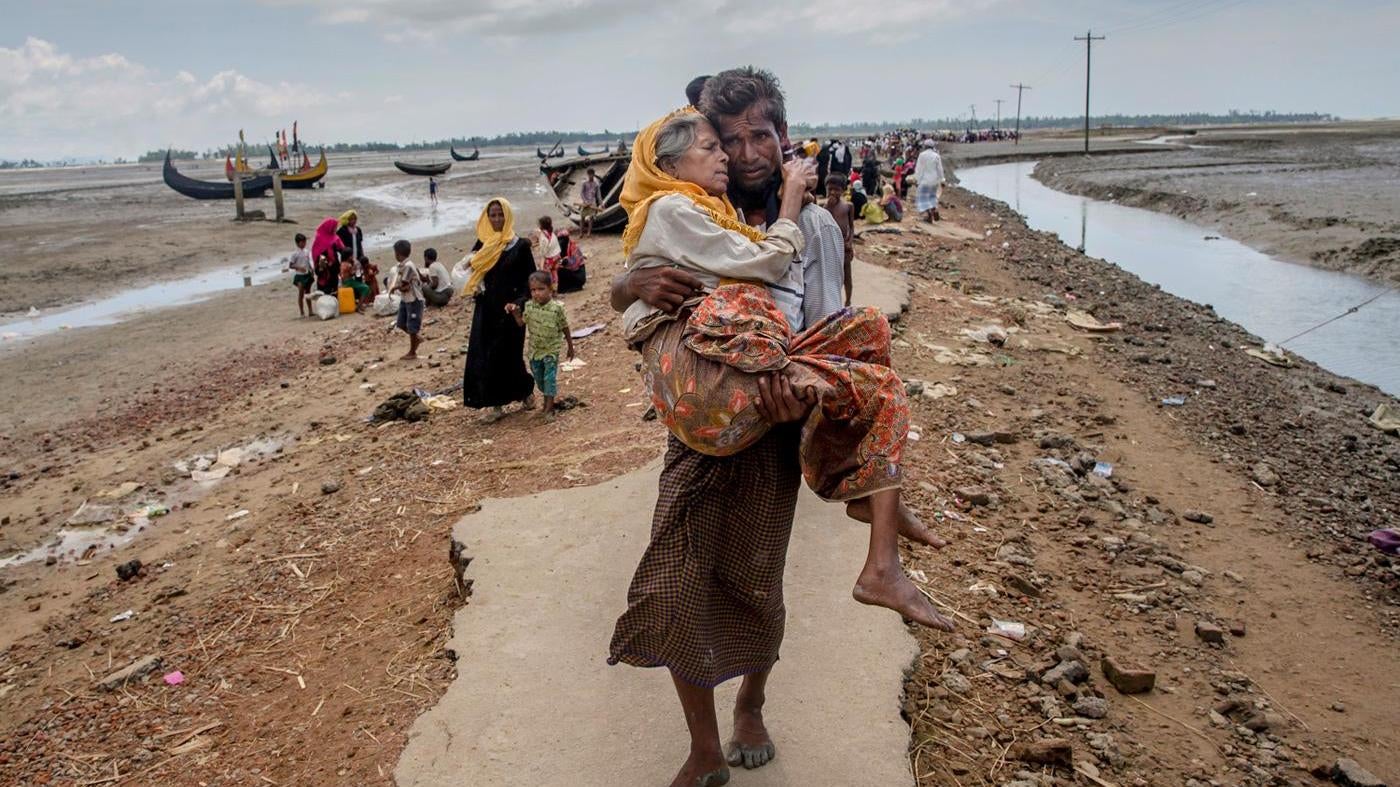
Atrocities against Rohingyas
Between 4 and 6 February 2024, the Arakan Army launched attacks on Rakhine BGP outposts in Maungdaw Township, later alleging without providing evidence that the Arakan Rohingya Salvation Army (ARSA) and Rohingya Solidarity Organization (RSO) fought alongside the Rakhine BGP. The RSO denounced AA’s accusations and the AA labeling them as “Bengalis” among other issues. Later in February when the junta began conscripting largely non-citizen displaced Rohingyas living in Kyaukphyu, AA spokesman, Khaing Thu Kha, called upon young Rohingya men fleeing conscription to seek refuge in their territory. The AA denied regime claims of targeting Rohingya for recruitment encouraging anyone regardless of ethnicity or religion to volunteer.
On 18 May 2024, when Arakan Army captured Buthidaung, Rohingya activists accused the Arakan Army of burning and targeting Rohingya homes in the town, a claim which the Arakan Army denied.
On 5 and 6 August 2024, AA forces launched attacks along the Myanmar-Bangladesh border, targeting thousands of fleeing Rohingya civilians. According to eyewitnesses and survivors, these assaults resulted in over a hundred deaths, including women and children, and countless injuries as they sought refuge, in Bangladesh. According to Rohingya news organization Kaladan Press, witnesses reported the intentional targeting of civilians using drones and heavy artillery.
RSO fighters were seen gathering in the area, with armed men seen running with the civilians.
Between March and August 2024, activist Nay San Lwin reported to The New Humanitarian that at least 2,500 Rohingya were killed, and approximately 40,000 were forced to flee the country by the Arakan Army.
On 29 August 2024, CNN reported that, based on eyewitness accounts that they could not independently verify, Rohingya refugees had experienced persecution from the Arakan Army in recent months during the group’s Rakhine State offensive against the Myanmar military. Numerous Rohingya refugees in Bangladesh’s Cox’s Bazar camp expressed to CNN the sentiment that the “AA wants to wipe out Rohingyas from Rakhine State”.
Bangladesh’s Refugee Relief and Repatriation Commissioner, Mohammed Mizanur Rahman, stated in April 2025 that Rohingya refugees claimed to be fleeing persecution from the Arakan Army who have enabled Arakanese people from Bangaldesh, Nepal and India to settle into Rohingya areas in Rakhine State. Pro-ULA media denied these claims, citing the unsuitability of these areas for settlement amidst active bombings and gunfire.
On 3 August 2025, the newly formed Arakan Rohingya National Council published photos showing human remains from a massacre allegedly committed by AA against at least 600 ngya in Htan Shauk Khan village, Buthidaung, on 2 May 2024.
AA spokesperson Khaing Thu Kha denied AA’s responsibility, calling the allegations a smear campaign stating that the bodies were Tatmadaw soldiers and Muslim conscripts, citing military headwear and boots present in the photos.
Tatmadaw spokesperson Zaw Min Tun denied its troops were present in the area at the time, while ULA chief administrator Aung Thaung Shwe argued that the village was close to the 551st battalion base where heavy fighting had occurred around that time.